

SOLD: 24 Hour Fitness— $14,000,000 at a 10% Cap
Why this might be one of the best net-lease buys in recent memory, and what it means for LA apartment owners sitting on low-cap equity
I don't write a post every time a deal closes. But this one deserves it.
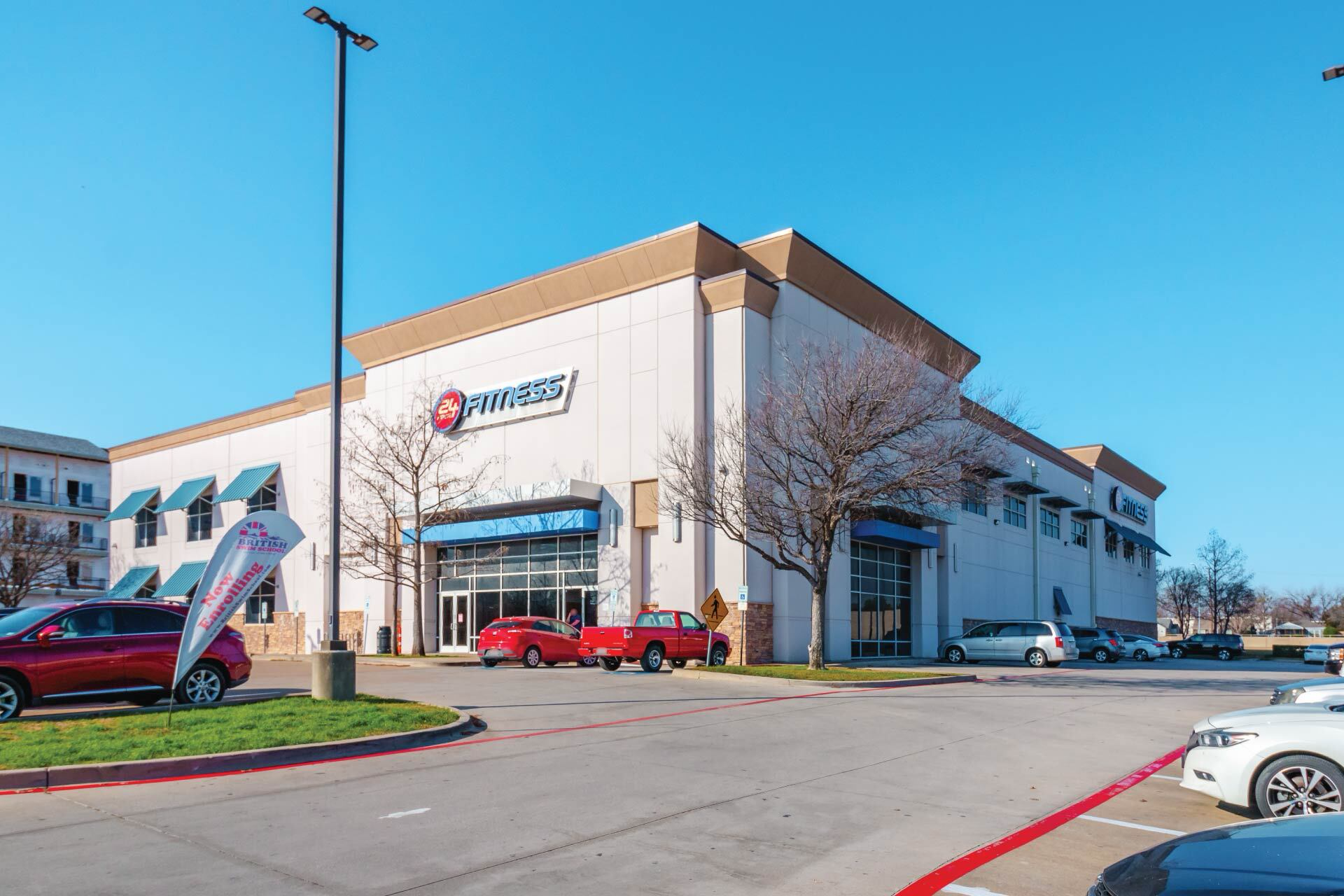
I sold 2701 Halloran Street in Fort Worth, Texas — a freestanding 42,267-square-foot 24 Hour Fitness on a 3.93-acre hard-corner lot with frontage on Interstate 30. The property closed at $14,000,000, which against $1,400,000 of NOI works out to a 10.0% cap rate. Ten years of corporate NNN lease term remaining. Four five-year options after that. Contractual rent increases built into the lease. And the buyer assumed the existing $10.1 million loan at a fixed 4.495% — which pushes the cash-on-cash return to roughly 24%.
Let me put that in the plainest terms I can: the buyer is collecting $1.4 million a year, with the tenant paying the taxes, the insurance, and the maintenance, on a building the buyer will never have to think about on a Saturday. That's the deal.
The property
Here's what the buyer picked up, straight from the offering materials:
Building: 42,267 SF, built in 2008, single-tenant, purpose-built fitness box
Land: 3.93 acres, hard corner at Halloran Street and Calmont Avenue, immediately off I-30 (roughly 60,500 vehicles per day)
Tenant: 24 Hour Fitness USA, LLC — corporate lease, 280+ clubs nationally
Lease: Absolute NNN, ~10 years remaining on the initial term, (4) 5-year options
Rent: $1,400,000/year ($33.13/SF), stepping up to roughly $1,480,000/year in mid-2030 per the lease schedule, with further structured bumps in the option periods
Location: 4.5 miles from Texas Christian University, 5.5 miles from downtown Fort Worth, in the Western Hills/Ridglea submarket, with a five-mile trade area of 272,000+ people projected to keep growing
And the part that isn't in any brochure yet: a brand-new 401-unit apartment community, Jefferson Ridglea Village at 5885 Calmont Avenue, was just delivered in 2026 immediately adjacent to the site. That's over 305,000 square feet of Class A residential — hundreds of new renters, many of them the exact demographic that signs a gym membership, within walking distance of the front door. That is a durable, growing customer base landing right on top of the tenant — it strengthens the lease today and it strengthens the real estate on the back end.
This club also absorbed members from several nearby 24 Hour Fitness locations that didn't reopen after the pandemic. It is the consolidated, high-performing store in its submarket, not a marginal one.
Why a 10% cap on this asset is remarkable
Anyone who follows net lease knows where corporate-guaranteed NNN deals with ten-plus years of term have been trading. A 10% cap on a 2008-vintage building, on a hard corner off a major interstate, in the fifth-largest city in Texas, with a national tenant and contractual escalations, is an outlier. When I ran this against comparable single-tenant retail across the Sun Belt, nothing with this combination of term, credit, and real estate quality priced anywhere close.
Part of what created the opportunity was the fitness category itself — some buyers still discount gyms reflexively. But this is a box that has been open and paying rent since 2009, sitting on nearly four acres of freeway-visible land, with residential density being added next door. The buyer looked at the fundamentals instead of the label, and got paid for it.
I'll say it directly: I think this will go down as one of the best net-lease purchases I've seen in recent history. Time will prove me right or wrong, but the math is hard to argue with.
The financing is what takes this from great to exceptional
Here is the piece that most people will miss if they only look at the cap rate.
The buyer assumed the seller's existing loan: $10,100,000 at a fixed 4.495%, interest-only through the April 2029 maturity. No new loan, no rate shopping, no 7%+ debt quote from a lender who's nervous about fitness.
Run the numbers:
Purchase price: $14,000,000
Assumed loan: $10,100,000 @ 4.495% fixed, interest-only
Equity required: $3,900,000 (~72% LTV)
NOI: $1,400,000
Annual debt service: ~$454,000
Annual cash flow after debt: ~$946,000
Cash-on-cash return: ~24%
Debt coverage ratio: 3.08x
Read that cash-on-cash line again. The buyer put in $3.9 million and is clearing roughly $946,000 a year in net cash flow, with the tenant paying the operating expenses and the rent stepping up in 2030. That is a sub-five-year payback on equity from a corporate NNN lease. In today's rate environment, where new acquisition debt is priced well above this asset's cap rate for most product types, being able to step into a 4.495% loan is worth millions in itself.
And when the loan matures in 2029, the buyer will be refinancing a property with roughly seven years of primary term still remaining, four options behind it, and a 401-unit apartment community fully stabilized next door.
Now compare that to your apartment building
This is the part I actually want LA apartment owners to hear, because most of the clients I talk to at ApartmentValuation.com are sitting on exactly the situation I'm about to describe.
You own a building in the Valley or on the Westside. You bought it a long time ago, you've paid it down, and on paper you have a lot of equity. But look at what that equity is actually earning you:
Cap rate: most rent-controlled LA multifamily is trading somewhere in the 4.5%–5.5% range. On your current market value, that is what your money is producing.
Expenses: you carry the taxes, the insurance (which has gone up sharply), the water, the trash, the gardener, the plumber, the roofer, and the manager.
Rent control: RSO caps how fast you can move rents, no matter what the market does.
Tenant and legal risk: evictions, relocation payments, habitability claims, and a regulatory environment that gets harder every year — TCOPA and Measure ULA being the latest examples.
Your time: 3 a.m. phone calls, turnover, inspections, the city.
Now hold that next to the Fort Worth deal:
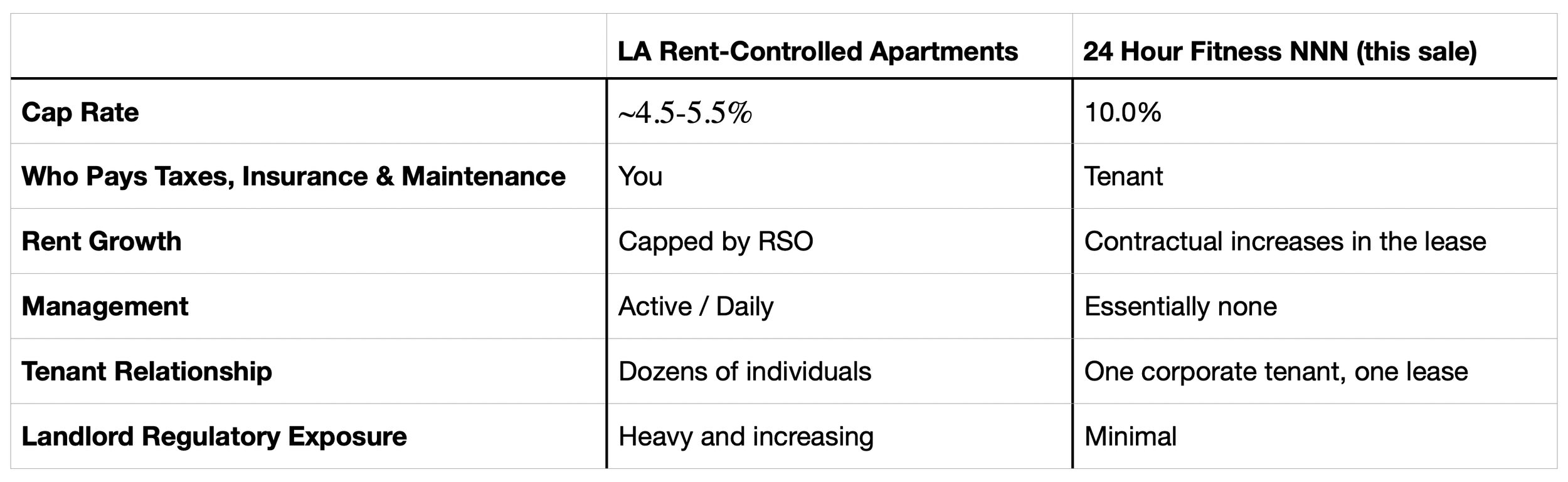
On a like-for-like basis, a dollar of equity moved out of a 5% cap building into a 10% cap NNN asset doubles the income, and does it with a fraction of the headaches. Add the fact that the tenant is covering the operating expenses, and the net spread is even wider than the cap rates suggest.
The 1031 exchange makes it work
None of this is theoretical. The mechanism that lets an LA apartment owner make this move without writing a check to the IRS is the 1031 exchange, and it's something I structure regularly.
A simplified example. Say you sell a Valley apartment building for $5,000,000 at a 5% cap, generating $250,000 of NOI — before you pay your operating expenses and deal with your tenants. You exchange into a NNN property at a cap rate similar to Fort Worth. The same $5,000,000 now produces roughly $500,000 of net income, the tenant handles the expenses, and you've deferred the capital gains and depreciation recapture tax that would otherwise have taken a large bite out of your proceeds.
Layer in financing and the story gets better. Net-lease assets with corporate tenants are highly financeable, and in this case the buyer didn't even need new debt — assuming the existing 4.495% loan is what pushed the return from a 10% cap to roughly 24% cash-on-cash. Assumable, below-market debt is one of the most overlooked sources of value in net lease right now, and it's something I specifically hunt for when placing exchange buyers.
Who this is for
This isn't for everyone. If you're a value-add operator who lives for the renovation and the repositioning, keep doing that. But if any of these describe you, it's worth a conversation:
You've owned your building for 15+ years and your equity has outgrown your income
You're tired of being an operator and want to be an investor
You're planning for retirement, or for passing wealth to the next generation, and want simplicity
You've watched insurance, ULA, and RSO changes eat into your margins and you don't see it reversing
You want your rental income to keep up with — or beat — what you'd earn in a bond, without giving up real estate ownership and the tax benefits that come with it
Let's run your numbers
Every apartment owner I work with starts the same way: I tell you what your building is worth, at no cost and with no obligation, and then we look honestly at what that equity could produce somewhere else. Sometimes the answer is hold. Sometimes it's a move like the one I just closed in Fort Worth.
If you want to see what a 1031 into net lease would look like for your building, reach out. I'll walk you through the math the same way I walked this buyer through it.
Figures reflect the closed sale and the seller's offering materials. This post is for informational purposes and is not tax or legal advice. Consult your CPA and attorney before entering into a 1031 exchange.
NOTE: The information provided on this website and this post is for general informational purposes only and is not intended as financial, tax, legal, or real estate advice. We are not licensed accountants, attorneys, estate planners, or real estate appraisers. All valuations, market analysis, and content are provided as educational information only. Any financial, tax, legal, or real estate decisions should be made in consultation with qualified professionals such as a licensed real estate appraiser, accountant, attorney, or financial advisor. Results and outcomes will vary based on individual circumstances.
Keywords: NNN investment, increase cash flow, 1031 exchange

Jake Plewa
Senior Director, RE/MAX Commercial & Investment Realty — TR Multifamily
310.922.6124 | jake@apartmentvaluation.com apartmentvaluation.com