


The 1031 Exchange Explained:
How LA Apartment Owners Can Defer Capital Gains and Keep Building Wealth
Note: The information provided on this website and this post is for general informational purposes only and is not intended as financial, tax, legal, or real estate advice. We are not licensed accountants, attorneys, estate planners, or real estate appraisers. All valuations, market analysis, and content are provided as educational information only. Any financial, tax, legal, or real estate decisions should be made in consultation with qualified professionals such as a licensed real estate appraiser, accountant, attorney, or financial advisor. Results and outcomes will vary based on individual circumstances.
By: Jake Plewa Commercial Real Estate Sales & Valuation, Los Angeles
Of all the tax strategies available to real estate investors, the 1031 exchange is arguably the most powerful — and the most misunderstood. I’ve sat across the table from apartment owners who have held their buildings for 20+ years and walked away from sales leaving hundreds of thousands of dollars in unnecessary taxes on the table, simply because they didn’t understand how a 1031 works or assumed it was too complicated to execute. It doesn’t have to be. Let me break it down plainly.
What Is a 1031 Exchange?
A 1031 exchange — named after Section 1031 of the Internal Revenue Code — allows you to sell an investment property and defer federal capital gains taxes by reinvesting the proceeds into a “like-kind” replacement property. Instead of handing 20–37% of your gain to the IRS in the year you sell, that capital stays working for you in the new investment. In Los Angeles, where apartment buildings have often appreciated 300–500% or more over the past few decades, the tax liability on a sale can be staggering. I regularly work with owners sitting on $2–5M in embedded gain. A 1031 exchange is frequently the single most important financial decision in their entire ownership journey.
The Basic Rules You Need to Know
The IRS has specific requirements for a valid exchange. Get these wrong and the tax deferral disappears.
Like-Kind Property
“Like-kind” is broader than most people expect. You don’t have to swap apartment buildings for apartment buildings. You can sell a 10-unit in Koreatown and buy an industrial building in the Inland Empire, a strip mall in Phoenix, or a triple-net (NNN) retail property in Texas. As long as both properties are held for investment or business use, they qualify.
The Two Critical Deadlines
This is where I see owners run into trouble:
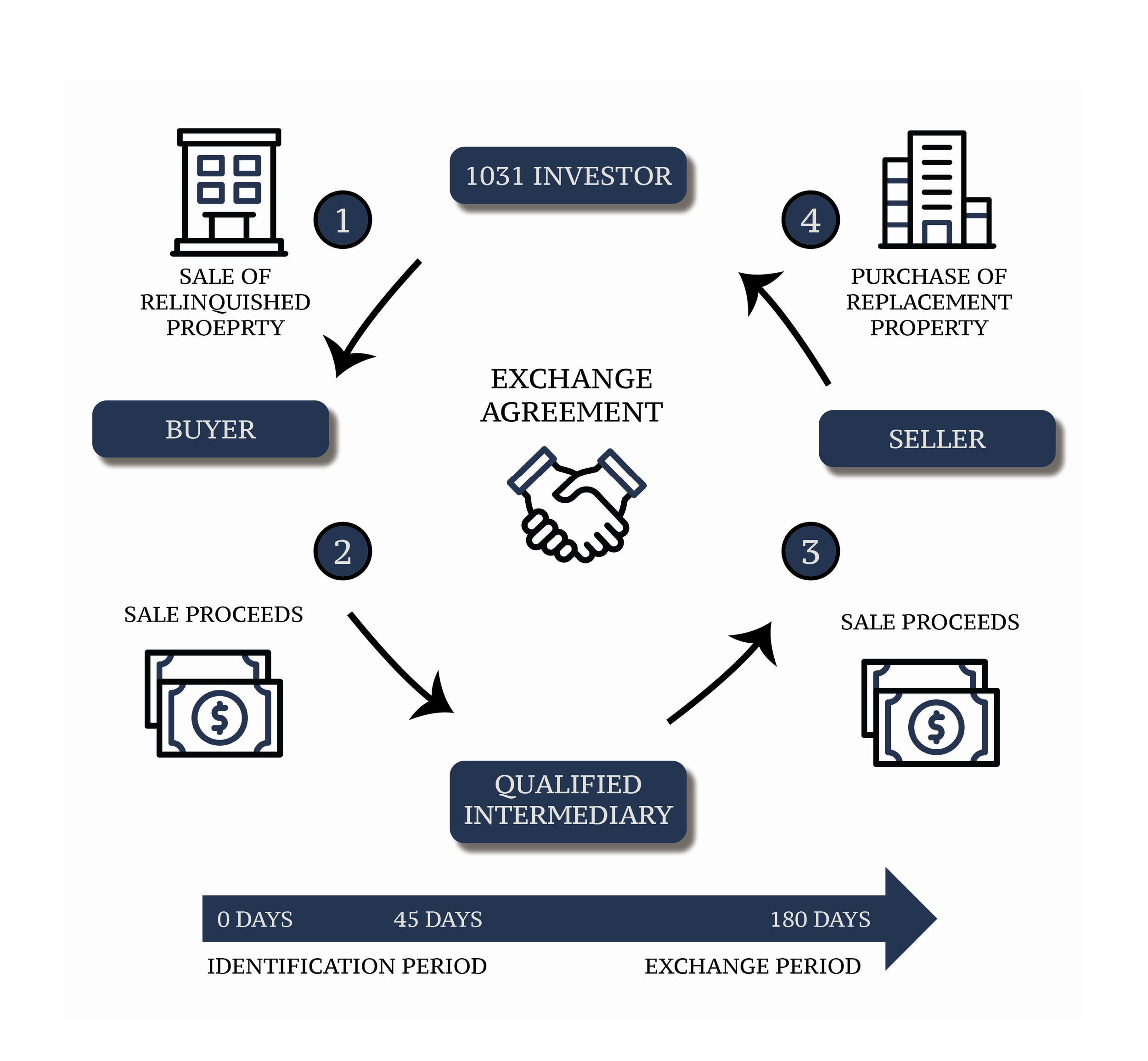
1. 45-Day Identification Period: From the date you close on your sale, you have exactly 45 calendar days to formally identify your replacement property (or properties) in writing. No extensions. Miss this and your exchange fails.
2. 180-Day Exchange Period: You must close on your replacement property within 180 days of selling your relinquished property (or by your tax filing deadline, whichever comes first).
These are hard deadlines. The moment you close your sale, the clock starts. This is why working with an experienced Qualified Intermediary (QI) and having a clear acquisition strategy before you sell is essential.
The Qualified Intermediary (QI)
You cannot touch the money from your sale. Period. A Qualified Intermediary must hold the proceeds between transactions. If the funds hit your bank account — even for a day — the exchange is disqualified. Choose your QI carefully; this is not a place to cut corners.
Boot and Partial Exchanges
To fully defer your taxes, you must reinvest all of the net proceeds and acquire a property of equal or greater value. If you don’t reinvest everything — maybe you want to pocket some cash — that difference is called “boot,” and it’s taxable. Partial exchanges are still worth doing; you just pay taxes on the boot portion and defer the rest.
What About California State Taxes?
California does not conform to the federal 1031 exchange rules in quite the same way. If you do a 1031 exchange into a property outside of California, the Franchise Tax Board has a clawback mechanism: they can eventually collect state capital gains tax when the replacement property is sold, even if that sale happens in another state. That said, this doesn’t make out-of-state exchanges unwise — especially if you’re moving equity from a high-management, low-cap-rate LA asset into a higher-yield property elsewhere. It simply means you need to factor California’s eventual bite into your long-term planning. To fully defer your taxes, you must reinvest all of the net proceeds and acquire a property of equal or greater value. If you don’t reinvest everything — maybe you want to pocket some cash — that difference is called “boot,” and it’s taxable. Partial exchanges are still worth doing; you just pay taxes on the boot portion and defer the rest.
1031 Alternatives Worth Knowing
Sometimes a traditional 1031 isn’t the right fit — maybe you’re tired of active management, or you can’t find a suitable replacement in time.
Here are two alternatives I discuss with clients regularly:
Delaware Statutory Trusts (DSTs)
A DST is a pre-packaged, institutional-quality property (apartment complexes, distribution centers, medical office, etc.) that qualifies as like-kind property for 1031 purposes. You exchange your proceeds into a fractional ownership position and receive passive income — no more tenant calls, no more maintenance headaches. DSTs are an increasingly popular solution for owners who want to preserve their capital but exit active management.
Installment Sales
If the idea of reinvesting doesn’t appeal to you, an installment sale allows you to spread your capital gains recognition over several years, rather than taking the full tax hit in year one. It’s not a deferral, but it can meaningfully reduce the tax rate you pay in any given year by keeping you out of the top brackets.
The Strategic Play for LA Apartment Owners
Here’s how I think about it from a valuation and market perspective: Los Angeles apartment cap rates have compressed significantly. Many buildings in the 4–6 unit range are trading at sub-4% cap rates in prime neighborhoods. That’s a thin return for the management intensity. A 1031 into a higher-yielding asset — whether that’s a larger LA multifamily building, a commercial property, or an out-of-state asset — can dramatically improve your cash-on-cash return while preserving every dollar of your equity. The owners who use 1031 exchanges strategically don’t just defer taxes once — they chain exchanges over time, continuously upgrading their portfolio while their equity compounds tax-free for decades.
A Few Closing Thoughts
I am not a CPA or tax attorney, and every exchange should be structured with qualified tax and legal counsel. But as someone who handles the real estate side of these transactions every day, I can tell you: the clients who plan their exit strategy — including their 1031 — well before they list their property are the ones who end up with the best outcomes. If you’re thinking about selling your LA apartment building and want to understand how a 1031 might factor into your decision, let’s talk through the numbers together.
Want to explore your options before you list?
Contact us for a confidential conversation about your property and what a strategic sale could look like.
Jake Plewa jake@apartmentvaluation.com(310) 922-6124
NOTE: The information provided on this website and this post is for general informational purposes only and is not intended as financial, tax, legal, or real estate advice. We are not licensed accountants, attorneys, estate planners, or real estate appraisers. All valuations, market analysis, and content are provided as educational information only. Any financial, tax, legal, or real estate decisions should be made in consultation with qualified professionals such as a licensed real estate appraiser, accountant, attorney, or financial advisor. Results and outcomes will vary based on individual circumstances.Keywords: 1031 exchange Los Angeles, defer capital gains apartment, 1031 exchange rules California, like-kind exchange real estate, Los Angeles apartment building sale, DST Delaware Statutory Trust, 1031 exchange apartment owner